Exploring your missing tooth options can raise plenty of questions. Should you choose an implant, a bridge or a removable partial denture? And does every missing tooth need the same approach?
The most useful starting point is understanding what each option involves and what your remaining teeth can support.
Discussing Your Missing Tooth Options
At a consultation in Maple Ridge, explain what bothers you most: chewing, appearance, speech or keeping the area clean. Bring a list of questions and tell the dentist about previous treatment. Ask which findings matter for your choices before discussing a particular appliance.
How Does a Dental Implant Work?
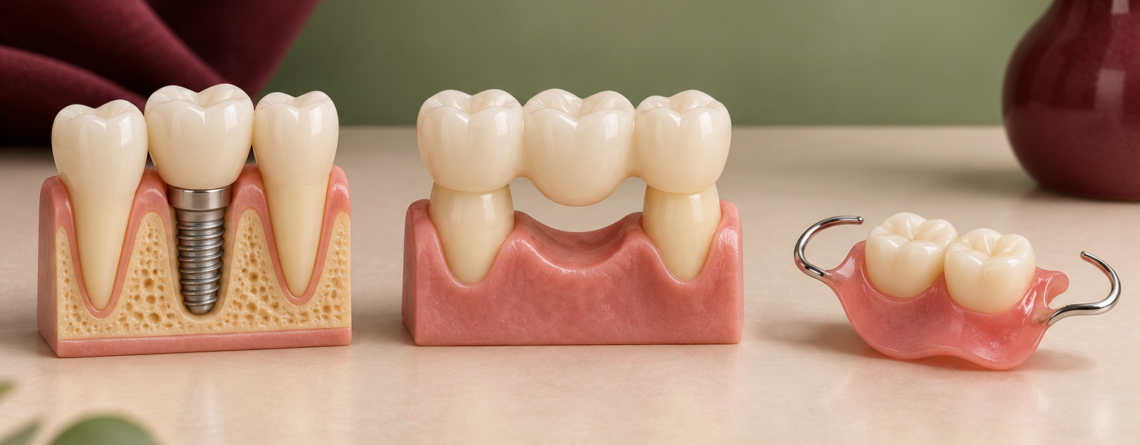
An implant is a post placed in the jawbone to support a crown or another replacement. An assessment checks gum health, available bone and medical factors. Some people need additional preparation, such as bone grafting, or referral to another clinician.
Treatment usually involves healing time and several stages. Surgery carries risks, and implants are not suitable for every patient. They also need ongoing cleaning and dental checks. Our dental implants page explains more about assessment and treatment.
When Might a Bridge Be an Option?
A traditional bridge uses neighbouring teeth to hold a replacement across the gap. The dentist usually reshapes those supporting teeth for crowns. Depending on the location and the condition of the teeth, your dentist may suggest other bridge designs.
A bridge stays in place and needs cleaning underneath the replacement tooth. Ask how the proposed design would affect the supporting teeth and whether you can comfortably maintain it. See our bridges and dentures information for related care.
What Is a Removable Partial Denture?
A partial denture can replace one or several teeth while some natural teeth remain. You take it out for cleaning and usually overnight. Its design depends on the pattern of missing teeth and the support available.
Ask about the fit, visible clasps, adjustment visits and daily cleaning. A partial denture may feel unfamiliar initially, and changes in the mouth can mean the fit needs checking over time.
Comparing Missing Tooth Options at Your Visit
- Which options are appropriate for my mouth, and why?
- Would healthy neighbouring teeth need to be reshaped?
- Is surgery involved, and what are the main risks?
- What happens between treatment stages?
- What would daily cleaning involve?
- What does the written estimate include?
When comparing estimates, ask whether assessments, imaging, temporary replacements, laboratory work and follow-up are included where relevant. Confirm any dental-plan contribution before deciding. A quoted price is easier to understand when the proposed steps are clear.
Frequently Asked Questions
Is an implant always better than a bridge?
No. Implants and bridges have different requirements. Ask your dentist to explain the trade-offs for your teeth rather than choosing from a general ranking.
Can I leave the space alone?
In some situations, monitoring may be discussed. In others, changes in chewing or nearby teeth can make replacement worth considering. An examination helps clarify the likely consequences for that particular space.
Will the replacement last forever?
No option comes with a lifetime guarantee. Ask about maintenance and what may need repair or replacement later.
Sources
- Canadian Dental Association: Dental Implants
- Canadian Dental Association: Bridges
- Canadian Dental Association: Dentures
This article provides general information and does not replace an individual dental assessment or your dental team’s instructions.