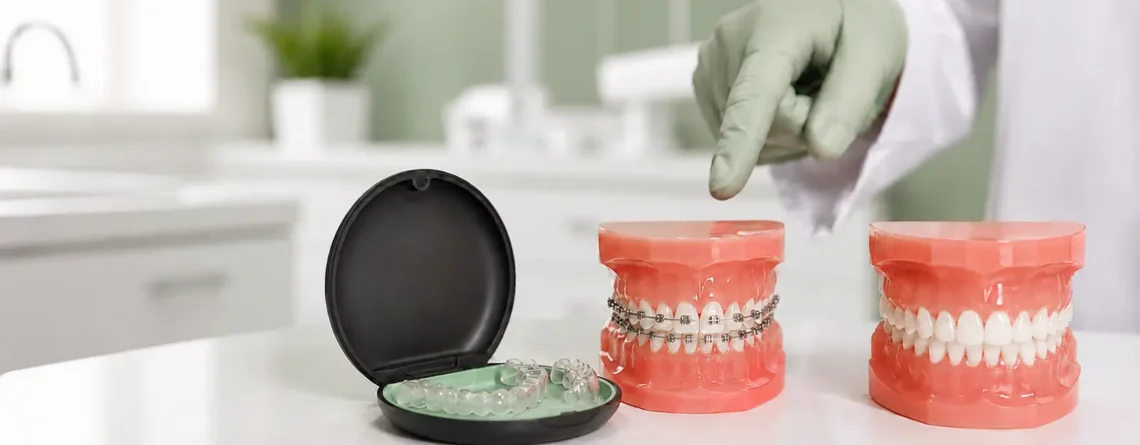
Clear aligners and braces can both move teeth and improve a bite, but they work differently in daily life. The best choice is not simply the least visible or the fastest-looking option. It depends on your teeth, bite, treatment goals, oral health and ability to follow the treatment plan.
Clear aligners and braces at a glance
| Feature | Clear aligners | Braces |
|---|---|---|
| Appearance | Transparent trays are less noticeable. | Brackets and wires are visible; ceramic options may be less noticeable. |
| Removability | Removed for meals, brushing and flossing; must be worn as prescribed. | Fixed to the teeth throughout active treatment. |
| Food | No appliance-related food restrictions while trays are removed; teeth should be cleaned before reinsertion. | Hard, sticky or very chewy foods may need to be avoided. |
| Cleaning | Teeth can be brushed and flossed normally, and trays require regular cleaning. | Cleaning around brackets and wires takes additional time and technique. |
| Responsibility | Success depends strongly on consistent wear and safe storage. | No need to remember trays, but careful appliance care is essential. |
| Adjustments | New trays are introduced on a prescribed schedule with monitoring visits. | Wires or other components are adjusted during visits. |
| Suitability | Can treat many alignment and bite concerns, but not every case predictably. | May be preferable for some complex movements or patients who need a fixed approach. |
How clear aligner treatment works
Clear aligner treatment uses a planned series of custom transparent trays. Each stage applies controlled pressure to guide teeth toward their prescribed positions. Your records may include photographs, X-rays and a digital scan. Some cases also use tooth-coloured attachments or elastics to support specific movements.
Aligners are removed for eating and for beverages other than water. They must be worn for the schedule prescribed by the dentist and stored safely when out of the mouth. Monitoring appointments allow the dentist to assess progress and adjust the plan when necessary.
How braces work
Braces use brackets attached to the teeth and wires or other components to apply controlled forces. Because the appliance remains in place, treatment does not rely on remembering to wear trays. Braces can be an effective option for a wide range of tooth movements, including situations where precise fixed control may be helpful.
Patients need to clean carefully around the appliance and follow food instructions to reduce the risk of broken brackets, damaged wires, cavities and gum inflammation.
Who may prefer clear aligners?
- Adults or teens who want a less noticeable appliance
- Patients who value removing the appliance for meals and oral hygiene
- People who can reliably follow the prescribed daily wear schedule
- Patients whose alignment and bite concerns can be treated predictably with aligners
Who may prefer braces?
- Patients who do not want responsibility for removable trays
- People whose treatment may benefit from a fixed appliance
- Patients comfortable adapting eating and cleaning habits around brackets and wires
- Individuals for whom the clinical assessment identifies braces as the more predictable approach
Questions to ask at your consultation
- Which options are clinically appropriate for my teeth and bite?
- What records or imaging will be needed?
- What is included in the treatment fee, and what may cost extra?
- How often will monitoring appointments be needed?
- What happens if I lose an aligner or break a bracket?
- Will I need attachments, elastics, refinements or other appliances?
- What type of retainer will I need after treatment?
Frequently asked questions
Are clear aligners always faster than braces?
No single treatment-time promise applies to everyone. Timing depends on the starting problem, biological response, treatment goals and—for aligners—consistent wear. Your dentist can provide an estimate after examining you and reviewing the necessary records.
Are clear aligners painless?
No orthodontic tooth movement is completely sensation-free. Temporary pressure or tenderness may occur when starting a new aligner or after an adjustment. Contact the clinic if discomfort is severe, unusual or persistent.
Will I need a retainer?
Usually, yes. Teeth can shift after either aligners or braces, so retainers are commonly prescribed to help maintain the result.
Can every Invisalign case be treated by a general dentist?
No. Treatment complexity varies. Cases requiring advanced orthodontic management or possible jaw surgery should be referred to an orthodontist for assessment.
This article provides general information. Individual suitability, timing and outcomes can only be discussed after a clinical assessment.