Brushing and flossing are essential, but a toothbrush may not always
reach the deepest grooves of a child’s back teeth. Food and plaque can
remain in these narrow areas, increasing the risk of cavities even when
a child is making a good effort at home.
Dental sealants provide an additional layer of protection for
selected teeth. They are thin coatings placed over the chewing surfaces
of molars and premolars to help keep food and cavity-causing bacteria
out of vulnerable grooves.
Sealants are not necessary for every child or every tooth. A dental
examination can help determine whether they would be useful based on the
shape of the teeth, the child’s cavity risk and how well the areas can
be cleaned.
What Are Dental Sealants?
A dental sealant is a flowable material that settles into the pits
and fissures on the chewing surface of a back tooth. Once hardened, it
forms a smooth protective barrier over those grooves.
Sealants are usually tooth-coloured, clear or slightly tinted. They
are placed only on the chewing surface and do not cover the entire
tooth. The procedure is preventive: it aims to protect areas that are at
risk before a larger cavity develops.
Why Are Back
Teeth More Vulnerable to Cavities?
Molars do much of the chewing. Their surfaces contain natural hills
and valleys that help break down food, but some grooves are so narrow
that toothbrush bristles cannot clean them completely.
Children may face additional challenges because:
- Newly erupted permanent teeth can be difficult to reach and
clean. - Brushing skills are still developing.
- Frequent snacks or sweetened drinks increase the number of acid
attacks on teeth. - Orthodontic appliances or crowding may make home care more
difficult. - Some children have naturally deep pits and fissures.
- A history of cavities may indicate a higher future risk.
Sealants help protect the grooves, while fluoride toothpaste and
regular preventive care protect the rest of the tooth.
Which Children May
Benefit from Sealants?
Sealants are often considered when the permanent first molars appear,
usually around age six, and again when the second permanent molars
erupt, commonly around age twelve. These ages are only general
guides—teeth erupt at different times for different children.
A dentist may be more likely to recommend sealants when a child
has:
- Deep or difficult-to-clean grooves
- Previous cavities or early areas of enamel weakening
- Limited fluoride exposure
- Dry mouth or another factor that raises cavity risk
- Difficulty maintaining effective brushing
- Dietary or medical factors that increase the likelihood of
decay
Primary teeth may occasionally be sealed when their anatomy and the
child’s cavity risk make additional protection useful. Some adults with
deep, sound grooves and no existing restorations may also benefit. The
decision should be based on the individual tooth rather than age
alone.
What Happens During the
Appointment?
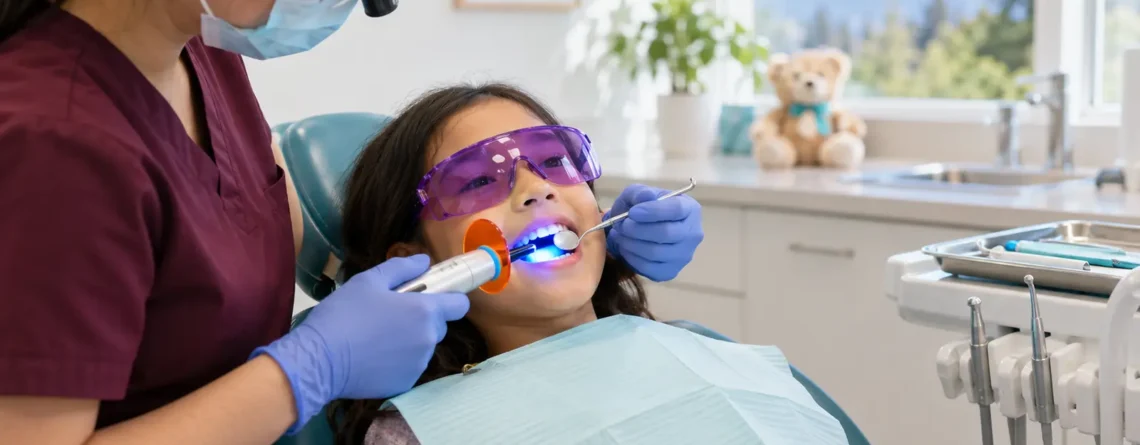
Applying a sealant is usually quick and does not require drilling or
local anesthetic when the tooth is healthy.
The general steps are:
- The tooth is cleaned.
- The chewing surface is kept dry and isolated from saliva.
- A conditioning material is applied briefly to help the sealant
bond. - The tooth is rinsed and dried.
- The sealant is flowed into the grooves.
- A curing light may be used to harden the material.
- The dentist checks the coverage and the child’s bite.
Keeping the tooth dry is important, so cooperation can affect whether
treatment is completed at that visit. The dental team can explain the
process in child-friendly language and help the child feel
comfortable.
Do Sealants Hurt?
Sealant placement is generally painless. The child may notice the
taste of the materials, feel air or water around the tooth, or sense
that the tooth feels slightly different immediately afterward. The bite
should feel normal once the material has been checked and adjusted if
needed.
If a child is anxious, tell the dental team before treatment. A calm
explanation, breaks and a gradual approach can make the experience
easier.
How Long Do Dental Sealants
Last?
Sealants can remain protective for several years, but they are not
permanent. Chewing forces, grinding and normal wear can cause part of a
sealant to thin, chip or detach.
At routine dental examinations,
the dentist checks whether each sealant is still intact. A worn area can
often be repaired or the sealant reapplied. Regular monitoring matters
because a partially lost sealant may be difficult for families to notice
at home.
Do Sealants
Replace Brushing, Flossing or Fluoride?
No. Sealants protect only the covered grooves. Cavities can still
develop between teeth, along the gumline or on other unsealed
surfaces.
Children should continue to:
- Brush twice a day with an age-appropriate amount of fluoride
toothpaste. - Clean between teeth where the contacts are closed.
- Drink water regularly and limit frequent sugary snacks and
drinks. - Attend recommended dental examinations and hygiene visits.
- Follow any individualized fluoride or preventive
recommendations.
Parents may need to supervise or assist with brushing until a child
can clean every surface consistently.
Are Dental Sealants Safe?
Dental sealants have been studied extensively and are recommended by
major dental and public-health organizations as an effective option for
preventing cavities in appropriate teeth. The small amount of material
is applied and hardened in a controlled clinical setting.
If you have questions about the sealant material, allergies or your
child’s health history, discuss them with the dentist before treatment.
The dental team can explain which product is being considered and
why.
An Individual
Assessment Provides the Best Answer
Some children have shallow grooves and a low cavity risk, while
others benefit significantly from extra protection. Sealants work best
as part of a complete preventive plan—not as a substitute for daily
care.
Frequently Asked Questions
At what age
should a child receive dental sealants?
There is no single age for every child. Sealants are commonly
considered soon after permanent molars have erupted enough to keep them
dry during treatment—often around ages six and twelve. A dentist should
assess the actual tooth and the child’s cavity risk.
Can a sealant be
placed over an early cavity?
In selected situations, a dentist may seal a non-cavitated early
lesion after careful assessment. A tooth with an established cavity may
need a different treatment. Dental examination and, when appropriate,
diagnostic imaging help determine the safest approach.
Can my child eat
after sealants are placed?
Once light-cured sealants have hardened and the bite has been
checked, children can generally return to normal eating. Follow any
specific instructions given by the treating dental team.
What happens if a sealant
falls out?
The tooth should be checked. If the surface remains healthy and
sealant protection is still recommended, the material can often be
replaced. A lost sealant is not usually an emergency, but it should be
mentioned at the next appointment or sooner if the tooth is
uncomfortable.
Are sealants only for
children?
No. Some adults may benefit when they have deep, cavity-free grooves
that are difficult to clean. Existing fillings, decay and individual
risk all affect whether a sealant is suitable.
Sources
- American Dental Association: Dental
Sealants - American Dental Association and American Academy of Pediatric
Dentistry: Clinical
Practice Guideline for the Use of Pit-and-Fissure Sealants - Centers for Disease Control and Prevention: About
Dental Sealants - American Dental Association, MouthHealthy: Sealants
This article provides general information and is not a substitute
for individualized dental or medical advice.